

Table of Contents
- Quick Comparison: Personal Licence Training Courses
- APLH Course Cost: What You'll Actually Pay
- Online vs Classroom APLH Training
- How to Get a Personal Licence: Step-by-Step
- Why Cheap Personal License Training Courses Aren't Always the Best Deal
- Personal Licence Renewal and Refresher Requirements
- Conclusion: Choosing the Right Personal Licence Training Course
- Frequently Asked Questions
Last Updated: September 13, 2026
Quick Comparison: Personal Licence Training Courses
Finding cheap personal licence training courses is straightforward once you know what the qualification actually requires. The Level 2 Award for Personal Licence Holders (APLH) is the accredited qualification you need before applying for a Personal Licence in England and Wales, and the Scottish Certificate for Personal Licence Holders (SCPLH) covers Scotland. Both are regulated qualifications, so the syllabus is fixed regardless of what you pay.
Below is a like-for-like comparison of what you'll actually pay for each route.
Course |
Format |
Price |
Best For |
|---|---|---|---|
APLH Online (England & Wales) |
Online + remote exam |
£125.00 |
Self-paced learners |
SCPLH Online (Scotland) |
Online + remote exam |
£125.00 |
Self-paced learners |
APLH Classroom |
One-day tutor-led |
£140.00 |
Learners who prefer face-to-face |
SCPLH Classroom |
One-day tutor-led |
£140.00 |
Learners who prefer face-to-face |
Exam Only |
Remote invigilated exam |
£85.00 |
Those who've already studied |
APLH Course + Application Service |
Online + full application handling |
£258.08 |
Anyone wanting the licence sorted end-to-end |
SCPLH Course + Application Service |
Online + full application handling |
£243.33 |
Anyone wanting the licence sorted end-to-end |
SCPLH-R Refresher (Online) |
Online refresher + exam |
£95.00 |
Existing Scottish licence holders |
SCPLH-R Refresher (Classroom) |
One-day refresher |
£100.00 |
Existing Scottish licence holders |
APLH Course Cost: What You'll Actually Pay
The APLH course cost starts at £125.00 for a fully online course with a remotely invigilated exam included. That figure covers the training module, the e-book study guide, and one free resit.


What catches people out is everything downstream. The course gives you the qualification; it does not give you the licence. You still need to apply to your local licensing authority, and that application carries its own fee, set by the authority and not by the training provider.
So when you compare APLH course cost across providers, compare the total: training, exam, resit policy, and whether application support is bundled. A £125 course with a free resit and tutor access is a different product from a £99 course where a failed exam means paying again.
Online vs Classroom APLH Training
Online and classroom APLH training cover the same accredited syllabus and lead to the same qualification. The difference is delivery, not content, but the delivery difference is bigger than most providers admit, because it changes how you sit the exam.
How remote invigilation actually works
If you book an online course, the exam is usually sat under remote invigilation. In practice that means:
- You book a slot in advance and log in at the scheduled time.
- You complete a system and identity check before the exam starts, webcam, microphone, and photographic ID.
- A remote invigilator monitors you live for the duration of the exam.
- You must sit alone in a quiet room, with no other people present, no phone within reach, and no notes on the desk.
- The session is recorded, and any flagged behaviour can void the result.
You need a laptop or desktop with a webcam and a stable connection. Mobile phones and tablets are not accepted for the exam, even if you studied on one.
When a physical test centre is the better choice
Some providers also offer the exam at a physical test centre, either on the same day as a classroom course or as a standalone sitting. A test centre suits you if:
- Your home setup is unreliable, shared accommodation, poor broadband, or no quiet room.
- You are not confident with technology and don't want the invigilation process itself to be a source of stress.
- You want the exam done and dusted on a fixed date rather than booked around your own schedule.
The trade-off is travel and a fixed date. Remote invigilation trades convenience for a stricter environment check on the day.
The format comparison in practice
Online + remote exam |
Classroom + same-day exam |
|
|---|---|---|
Study pace |
Self-directed, instant access |
Fixed one-day schedule |
Exam timing |
Booked at your convenience |
Sat the same day |
Environment |
Your own space, invigilated remotely |
Test centre or classroom |
Travel |
None |
Required |
Best for |
Shift workers, confident computer users |
Learners who want structure and a fixed date |
- Online: flexible timing, no travel, self-directed, remote invigilation
- Classroom: fixed date, tutor-led, exam on the day, physical setting
- Both: same qualification, same legal standing, same application route afterwards
A failed system check on exam day is treated as a missed sitting by most providers. Run the check the day before, not five minutes before your slot.
How to Get a Personal Licence: Step-by-Step
Getting a personal licence is a two-stage process: pass the qualification, then apply to your local licensing authority. The qualification is the part you can book today. The application is the part most guides skip, and it is where applications actually stall.
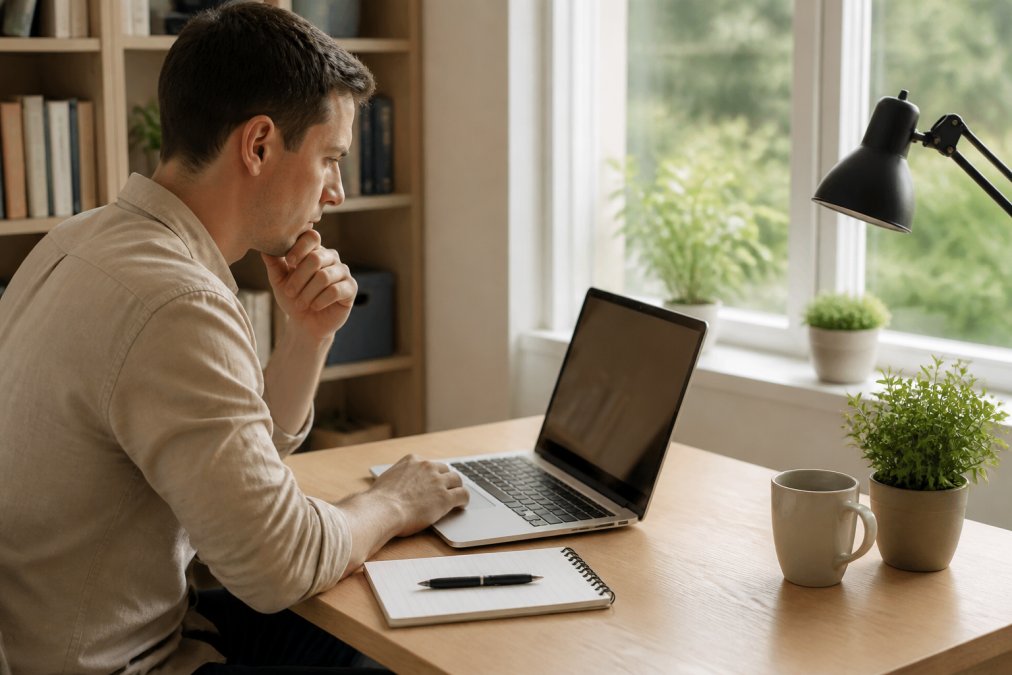
A student sat in the comfort of their own home, studying and doing the exam online.
Step 1: Book your accredited course. Choose the APLH for England and Wales or the SCPLH for Scotland, in online or classroom format. Confirm the awarding body before you pay, an unaccredited certificate will be rejected by the licensing authority regardless of the price.
Step 2: Complete the training and pass the exam. Study the module, then sit the remotely invigilated exam. You'll need a laptop or desktop (not a mobile or tablet), a working webcam, a stable connection, and photographic ID. The exam is multiple choice and the pass mark is set by the awarding body, not the training provider.
Step 3: Assemble your application pack. This is the stage that catches people out. A typical personal licence application to a licensing authority includes:
- The completed application form for the relevant licensing authority
- Your original APLH or SCPLH certificate (or the accredited equivalent)
- Two passport-style photographs, one of which must be endorsed as a true likeness by a person of standing, commonly a solicitor, teacher, accountant, doctor, or similar professional who has known you for at least two years
- A basic criminal record disclosure, or a declaration that you have no relevant convictions
- Proof of your right to work in the UK, where the authority requests it
- The application fee, paid to the authority
Step 4: Submit to the local licensing authority. In England and Wales, the application goes to the licensing authority for the area where you live, and a copy must also be sent to the relevant chief officer of police (gov.uk). In Scotland, the application goes to the licensing board for the area where you intend to hold or use the licence. Fees are set by each authority and vary, so check the current fee schedule on your own authority's website before you post anything.
Step 5: Wait out the statutory consultation period. The police have a fixed window to object on the basis of relevant convictions. If no objection is raised, the authority must grant the licence. If an objection is raised, the matter goes to a licensing committee hearing, and you have the right to make representations.
Step 6: Support your premises licence. If you're named as the Designated Premises Supervisor (DPS), your Personal Licence is a prerequisite. You cannot be named as DPS without one, and the premises licence holder must notify the authority of any change of DPS.
Passing the APLH or SCPLH is only half the job. The licence itself comes from your local authority, and a rejected application costs you weeks. Buy the qualification and the application support together if you're working to a deadline.
The two most common causes of delay are an unendorsed photograph and a missing or incorrectly completed disclosure. Check both before you submit, because the authority will return the pack rather than chase you for it.
Find your local licensing authority and current application fee
Why Cheap Personal License Training Courses Aren't Always the Best Deal
The cheapest personal license training courses are not automatically the worst, and the most expensive are not automatically the best. The real question is what sits inside the price.
A cheap course that excludes the exam fee, offers no resit, and leaves you to work out the application alone is not cheap. It's a low entry price with costs pushed downstream. The learners who get burned are the ones who compare headline figures and nothing else.
Here's how to judge value properly:
- Exam included? A course without the exam fee is not comparable to one with it.
- Resit policy? One free resit removes the risk of paying twice.
- Application support? Handling the licensing authority paperwork is the stage most likely to go wrong.
- Tutor access? Support you can actually reach when a question comes up.
- Accreditation? The qualification must come from an accredited awarding body or it won't be accepted.
That last point is the one people skip. An unaccredited "certificate" is worthless to a licensing authority, no matter how little you paid for it. Check the awarding body before you check the price.
Personal Licence Renewal and Refresher Requirements
Renewal rules differ by nation, and this is where a lot of licence holders get caught out. In Scotland, Personal Licence holders must complete refresher training within five years of their licence issue date to keep it valid (gov.scot). The SCPLH-R refresher course covers this requirement, and it's available online at £95.00 or as a one-day classroom course at £100.00.
In England and Wales, the position is different. The Personal Licence does not carry the same five-year refresher obligation, but the licence itself and the associated photograph must be kept up to date, and licensing authorities expect holders to remain familiar with current legislation. Always confirm your own position with your local licensing authority, because the rules that apply to you depend on where your licence was issued.
Letting a Scottish licence lapse through a missed refresher is not a paperwork inconvenience. It can invalidate your ability to sell alcohol, which affects your premises and your role as DPM (Designated Premises Manager) Diarise the five-year date the day your licence is issued.
Conclusion: Choosing the Right Personal Licence Training Course
The cheapest headline price rarely wins once you add the exam, the resit, and the application work. Buy on total cost and total support, not on the number in the advert.
Knight Training offers Personal Licence course and application service packages with a simplified three-step process, interactive learning modules, flexible online exam booking, and an expert team that handles the licence application for you. Courses are accredited by the Highfield Awarding Body and the British Institute of Innkeeping.

Scotland - Personal Licence Course + Application Service (Full Package)
Get started with Knight Training and take the guesswork out of your licensing requirements.
Frequently Asked Questions
How much does a personal licence course cost?
Course fees start at £85 for an exam-only option if you've already completed the learning. Full online courses cost £125, while classroom courses are £140. If you want the course plus help with your licence application, packages start at £243.33 for Scotland and £258.08 for England and Wales. All prices include VAT and a free resit.
Can I do my personal licence online?
Yes. Both the APLH and SCPLH qualifications are available as fully online courses. You study at your own pace and sit the exam remotely with invigilation. You'll need a PC or laptop with a webcam and photographic ID. Online courses start at £125 and include a free resit, so they're often the cheapest way to get qualified.
How difficult is the APLH exam?
The APLH exam is multiple-choice and tests your knowledge of licensing law and responsible alcohol retailing. The pass mark is typically around 70%. If you don't pass, most providers include a free resit. The key is to study the official syllabus and take practice questions before sitting the exam.
What are the legal requirements for a personal licence holder?
To hold a personal licence, you must be over 18, have the right to work in the UK, and hold an accredited qualification such as the APLH or SCPLH. You also need to pass a criminal record check and provide two passport photos and proof of address. In Scotland, you must complete refresher training every five years to keep your licence valid.
How long does it take to get a personal licence?
The training and exam can be completed in a day or over a few weeks online. Once you pass, your certificate is usually issued within a few days. The licence application itself is then processed by your local licensing authority, which can take several weeks. If you need to open a venue quickly, choose a course with an application service to avoid delays.