

Table of Contents
- Understanding Newspaper Advertising for Licence Applications
- Licensing Act 2003 Public Notice Requirements
- How to Write a Public Notice for a Licence
- Licensing Authority Notice Period and Timelines
- Common Mistakes in Premises Licence Applications
- Alternative Advertising Methods and Digital Options
- Getting Professional Support with Your Licence Application
- Frequently Asked Questions
Last Updated: October 4, 2026
Understanding Newspaper Advertising for Licence Applications
When you apply for a premises licence, you'll quickly discover that a public notice requirement isn't optional, it's a legal obligation under the Licensing Act 2003. At Knight Training, we help venue owners navigate this process so your application moves forward without delays.
You must publish a notice in a local publication at least once within 10 working days starting the day after you submit your premises licence application to the council.
According to Regulation 25 of the Licensing Act 2003 Regulations, advertising a new premises licence, provisional statement, or full variation requires strict adherence to specific timelines and content rules.
This public notice requirement exists to give local residents and responsible authorities the chance to object to your application. It's not a bureaucratic nuisance, it's a fundamental part of how the licensing system protects communities.
But here's where most applicants get confused. The rules around what you advertise, where you advertise it, and how long it must stay visible are strict. Get them wrong, and your application gets rejected. If the application is delayed, it will be expensive and time consuming.
This guide walks you through exactly what the law requires and how to write a compliant public notice. Whether you're opening a new pub, expanding a nightclub, or taking over a licensed venue, understanding these requirements upfront saves time and money.
Licensing Act 2003 Public Notice Requirements
The Licensing Act 2003 sets out mandatory advertising rules for premises licence applications, you must publish a notice in a local publication circulating in the area where your premises is located.
Here's what the law requires:
The Notice Must:
- Be published in a publication circulating in the licensing authority area
- Appear within 10 working days of submitting your application to the council
- Contain specific prescribed information about your application
- State the deadline for representations (objections)
Who Must Do This: If you're applying for a premises licence or a major variation, you're responsible for this advertising. Some applicants assume the council handles it, they don't. The burden falls on you, the applicant.
The Cost Factor: Newspaper advertising isn't free. This is a separate cost from your application fee to the council.
Why It Matters: The notice gives residents and responsible authorities (police, environmental health, trading standards, and others) a formal opportunity to raise concerns about your application. If someone objects, the licensing authority may request holding a hearing. (Knight Training will attempt to mediate with any objections) If your public notice doesn't meet the legal standards, your entire application can be rejected on technical grounds.
How to Write a Public Notice for a Licence
Writing a public notice that meets legal requirements is more precise than it sounds. The notice must contain specific information in a specific format. Miss one detail, and it may not satisfy the Licensing Act 2003 requirements.
Required Information in Your Notice:
Your notice must include:
- The name of the applicant
- The address of the premises
- A description of the licensable activities (e.g., retail sale of alcohol, provision of late-night refreshment, regulated entertainment)
- The proposed hours of licensable activities
- A statement that representations can be made within 28 days
- How and to where representations must be sent.
- A clear statement that objections must be made in writing.
Format and Language:
The public notice must be clear and legible. Use straightforward language, avoid jargon that confuses residents.
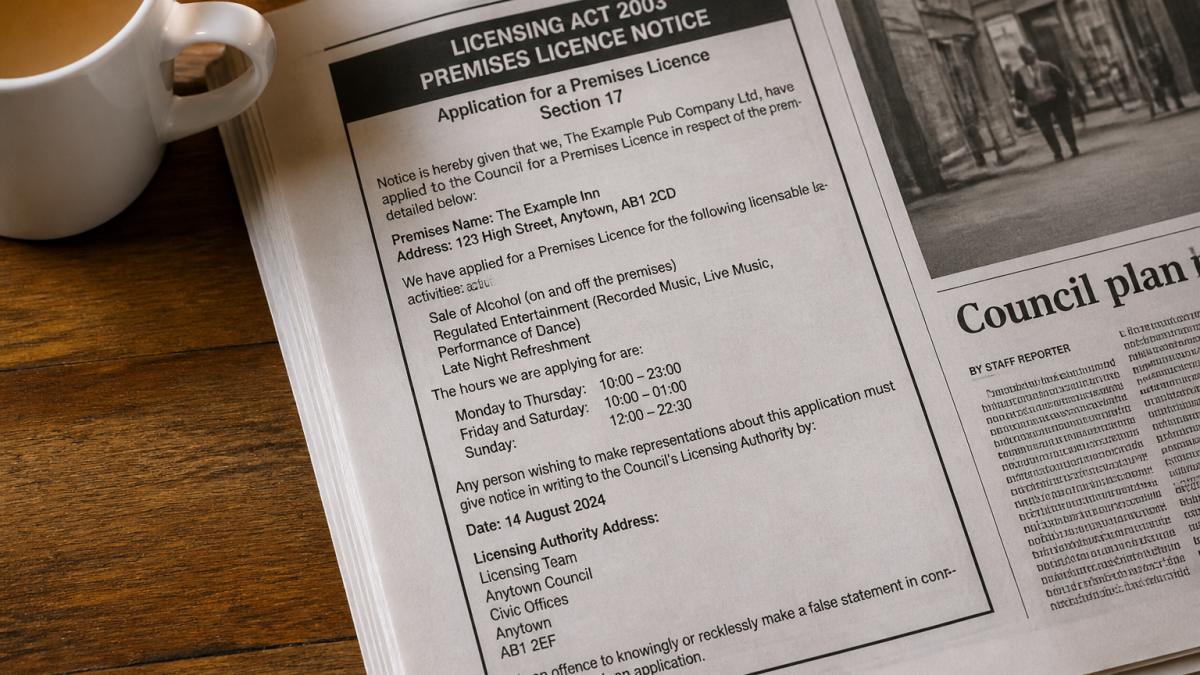
Close-up of a printed newspaper advertisement for a premises licence notice displayed on a table, showing the required text and details clearly visible
Common Pitfalls:
Many applicants submit notices that are vague about licensable activities. Instead of saying "the sale of alcohol," specify: "the retail sale of alcohol for consumption on and off the premises." Instead of "regulated entertainment," say "live music and the playing of recorded music."
The deadline for representations is also critical. You must state clearly that representations must be received within 28 days of the first publication date. If your notice doesn't include this, the licensing authority may consider the public notice to be incomplete.
Our Approach at Knight Training:
When you use our Licence Application Services, we produce the public notice for you. We ensure it meets all legal requirements and submit it to the local publication on your behalf. This removes the guesswork and reduces the risk of rejection on technical grounds. We will also use our experience to negotiate the price to that which an individual may be quoted by the local publisher.
Licensing Authority Notice Period and Timelines
Understanding the timeline for the public notice is essential for planning your application. The process has strict deadlines, and missing one can delay your licence approval by weeks.
The 10-Day Rule:
Your notice must be published within 10 working days of submitting your application to the licensing authority. This doesn't mean 10 calendar days, it means 10 working days (Monday to Friday, excluding bank holidays).
Here's the sequence:
- You submit your application to the council
- You have 10 working days to get the notice published
- Representations must be received within 28 days of the application being submitted to the Local Authority.
- The licensing authority then considers the application (and any representations)
Why This Matters:
If you miss the 10-day window, the licensing authority may reject your application. Some councils are flexible; others are strict. Don't assume your council will give you extra time.
Planning Ahead:
Before you submit your application, contact local newspapers and confirm:
- Their publication schedule
- How long they need to receive your notice before publication
- The cost of the notice
- Whether they can guarantee publication within your 10-day window
Some papers publish weekly; others publish multiple times per week. If you submit your application on a Friday and the newspaper only publishes on Thursdays, you've already lost time.
After Publication:
Once the notice is published, keep a copy of the newspaper showing the advert. You may need to send proof of publication to the licensing authority.
Common Mistakes in Premises Licence Applications
Most rejections and delays come from preventable errors. Here are the mistakes we see repeatedly, and how to avoid them.
Mistake 1: Vague Descriptions of Licensable Activities
Applicants often write: "Sale of alcohol and provision of entertainment."
This is too vague. The licensing authority needs to know exactly what you're doing. Write instead: "The retail sale of alcohol for consumption on and off the premises, the provision of late-night refreshment between 11pm and 5am, and the performance of live music."
Mistake 2: Publishing the Notice Too Late
You submit your application on a Monday. You contact the newspaper on Wednesday. They tell you they can't publish until the following week. You've now used five working days of your 10-day window.
Licence Application Services including Full Premises, Major Variations, DPS →
Always contact the publisher before you submit your application to the council. Confirm they can publish within your timeline.
Mistake 3: Incorrect Notice Wording
- The notice must explicitly state the exact final date by which representations must be received, calculated precisely as 28 consecutive days. Day 1 is the day after submitting the application to the Licensing Authority.
- Errors in dates or misleading wording can invalidate an application, forcing the applicant to re-display the blue notice or the public notice in the local publication.
Mistake 4: Forgetting to Keep Proof of Publication
The licensing authority requires proof that the notice was published. This means a copy of the publication with the notice clearly visible, or a statutory declaration from the publication confirming publication dates. Don't assume the publisher will send this automatically, request it in writing.
Mistake 5: Submitting an Incomplete Application Pack
Your application to the council must include:
- Completed Application Form: Details of the applicant (individual, company, or partnership), the address of the premises, and the nature of the business.
- Premises Plan: A scale plan (usually 1:100) showing the property boundaries, internal layout, access/egress points, toilets, stairs, fixed structures, and specific areas where licensable activities will take place.
- Application Fee: A statutory fee determined by the non-domestic rateable value (NDRV) of the premises.
-
Operating Schedule: A document outlining the licensable activities requested, the times they will take place, the opening hours, and steps planned to promote the four licensing objectives:
- Prevention of crime and disorder
- Public safety
- Prevention of public nuisance
- Protection of children from harm
- Any other documents required by your licensing authority
Missing even one document may trigger a request for further information, which could delay the process by weeks.
In addition to the above:
You must display a pale blue notice prominently at the premises for 28 consecutive days starting the day after you submit a premises licence application.
Display Rules for the Blue Notice
- Colour and Size: Must be pale blue and at least A4 size.
- Text: Printed or typed in black ink using a font size of 16 or larger.
- Placement: Placed where passers-by can easily read it from the outside 24 hours a day. Put a notice on every frontage if the building has more than one.
- Large Premises: Add an extra notice every 50 meters along the external perimeter if the premises is larger than 50 square meters.
Alternative Advertising Methods and Digital Options
Advertising in a local publication remains the legal requirement under the Licensing Act 2003, but the landscape is changing. Some licensing authorities are exploring digital alternatives, though these don't yet replace the newspaper requirement.
Current Legal Position:
As of 2026, the Licensing Act 2003 specifically requires publication in a local publication circulating in the licensing authority area. Digital-only notices do not currently satisfy this requirement, even if they reach more people.
However, some councils are piloting digital notice boards or online licensing portals where notices are also displayed. These supplement, but do not replace, the requirement to publish a public notice in your local area.
What You Can Do Alongside the public notice:
While you're legally required to advertise in a local publication, you can amplify your notice through:
- Your website or social media (informing customers and staff of the application)
- Email to local residents (if you have contact details)
- Local community newsletters or parish council bulletins
These additional steps don't satisfy the legal requirement, but they do increase awareness and transparency.
Emerging Digital Options:
Some councils are working with local newspapers to publish notices online as well as in print. This doesn't change your legal obligation, you still need the print version, but it extends the reach of your notice.
The Department for Levelling Up, Housing and Communities occasionally reviews licensing legislation. Keep an eye on official guidance for any changes to advertising requirements.
Getting Professional Support with Your Licence Application
Navigating the licensing process alone is possible, but it's time-consuming and error-prone. Many venue owners choose to work with a specialist to ensure their application meets all legal requirements.
What Professional Support Covers:
A dedicated licence application service typically handles:
- Completing all required application forms
- Liaising with the ten responsible authorities:
-
The 10 Responsible Authorities
We will liaise with:
- The Licensing Authority (your local council)
- Chief Officer of Police (local police force)
- Fire and Rescue Authority (local fire service)
- Local Planning Authority (council planning department)
- Environmental Health Authority (for public nuisance/noise control)
- Health and Safety Enforcing Authority (local council or HSE)
- Body responsible for the protection of children from harm (local safeguarding board)
- Weights and Measures Inspectorate (Trading Standards)
- Director of Public Health
- Home Office Immigration Enforcement (representing the Secretary of State)
- Producing a compliant public notice for publication.
- Submitting the notice to the publisher on your behalf
- Providing proof of publication to the licensing authority
- Advising on licensable activity operating hours and conditions
- Managing any objections or representations on your behalf, including those received from local residents, responsible authorities or interested parties.
Why It Matters:
The licensing process involves multiple stakeholders and strict deadlines. One missed step, a notice published one day too late, a form completed incorrectly, a missing document, can delay your licence approval by weeks or even months.
Knight Training's Licence Application Service:

Licence Application Services including Full Premises, Major Variations, DPS variations and Temporary Event Applications.
Our Licence Application Services covers the full premises licence process, including the public notice requirement. We produce your notice, arrange publication, and manage the entire application on your behalf.
Here's what you get:
- Expert completion of all application forms
- Liaison with all ten responsible authorities
- Public notice production and submission
- Proof of publication provided to the licensing authority
- Support throughout the licensing process
For Personal Licence Applicants:
If you're applying for a Personal Licence, the process is different, there's no public notice requirement. Instead, you submit your application directly to your local licensing authority. Our Personal Licence Application Service handles this for you, ensuring your application is accurate and complete.
Why Choose Professional Support:
Many applicants think they can save money by handling the application themselves.
Our team has processed hundreds of licence applications. We know the common pitfalls, the specific requirements of different councils, and how to mediate objections. Most importantly, we get applications approved the first time.
The requirement to advertise your licence application in a local publication is non-negotiable under the Licensing Act 2003. But understanding this requirement, and getting it right, is the difference between a smooth application process and a costly delay.
Frequently Asked Questions
Is a public notice mandatory for a premises licence application?
Yes. Under the Licensing Act 2003, a public notice is a legal requirement for a premises licence application. You must publish a notice in a local publication circulating in the area where your premises is located. Failure to comply with this requirement can result in your application being rejected.
What information must be included in a public notice for a licence?
Your public notice must include the name of the premises, the address, the licensable activities you intend to carry out (such as selling alcohol or providing late-night refreshment), and contact details for the licensing authority. The notice must also state the period during which representations can be made. The exact format and wording requirements are set out in the Licensing Act 2003 regulations, and using incorrect wording can delay your application.
How long must a public notice be displayed for a licence application?
The public notice must be displayed for at least once during the first 10 working days from the day after the application was submitted to the Licensing Authority. The timing is critical, as miscalculating this date is one of the most common mistakes that leads to application being delayed or rejected.
Can I use an online publication instead of a local publication for my public notice?
No. The Licensing Act 2003 requires publication in a local publication, not online publications. However, some local publishers now offer digital editions that still count as valid publications. You should confirm with your chosen publication that it meets the legal definition of a local publication under the Act. Professional application services can guide you through selecting an appropriate publication and ensure your notice complies with all requirements.